


28
Jan
Pervasive Pesticide Contamination of Beehives Across Europe, the First EU-Wide Study of Its Kind
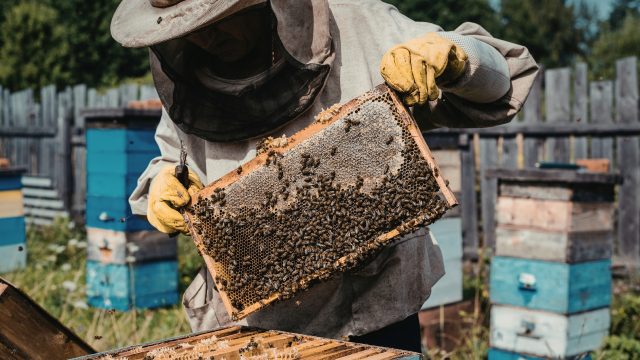
(Beyond Pesticides, January 28, 2026) A study published last year in Science of The Total Environment reports widespread pesticide contamination collected from beehive monitoring across the European Union (EU). “This study has produced the first EU-wide distribution map of terrestrial pesticide contamination and demonstrates widespread pesticide contamination of EU environments,” the authors write. The study, led by a cohort of citizen-scientists, documents pesticide drift across the European continent.
The results found that 188 of the 429 targeted pesticide compounds were detected in noninvasive, in-hive passive samplers (APIStrips) across 27 EU countries between May and August of 2023. This finding emerges at a time when public health and environmental advocates raise concerns about the European Union’s backtracking on commitments to reduce pesticide use by 2030, although the European Commission announced in July 2025 that “the use and risk of chemical pesticides has decreased by 58% by 2023 [from the 2015-2017 reference period], while the use of more hazardous pesticides fell by 27% over the same period.”
Results
The study results reveal that no landscape is safe from pesticide exposure, despite the European Union having better regulations in place than most other countries/regions. The researchers found:
- “There was no sample site where there was no pesticide occurrence over the complete sampling period.”
- “Four pesticides: acetamiprid (insecticide); azoxystrobin (fungicide); boscalid (fungicide); and tebuconazole (fungicide) were detected in all 27 EU countries in more than 50% of the sampling sites.”
- “The 31 most frequently detected pesticides (Annex III) across all EU countries were selected based on their occurrence in more than 40 sampling sites (approximately 10% of the total) in all sampling rounds, and with more than 100 individual detections.”
- Fungicides (16) – azoxystrobin, boscalid, fluopyram, tebuconazole, pyraclostrobin, trifloxystrobin, mandipropamid, fluxapyroxad, fludioxonil, difenoconazole, thiabendazole, carbendazim, cyprodinil, ametoctradin, metconazole, and propamocarb;
- Insecticides (12) – acetamiprid, permethrin, cypermethrin, acrinathrin, imidacloprid, chlorfenvinphos, pyriproxyfen, chlorpyrifos, fipronil, thiacloprid, deltamethrin, and chlorantraniliprole; and
- Herbicides (3) – metolachlor, dimethenamid, and pendimethalin.
- “Of particular concern is the frequent and widespread detection of several compounds, especially insecticides, that are currently not authorized as phytosanitary products in the European Union due to the high potential for harm to human health and the environment. Notably, this includes thiacloprid, permethrin, carbendazim, chlorpyrifos, and chlorfenvinphos (Fig. 4), which were detected in more than 60 apiaries, each with over 100 individual detections.”
- “[W]hile the most commonly detected pesticides are generally present at low concentrations, certain substances may be applied intensively at specific times, leading to high concentrations during particular periods. This reflects variations in application practices and usage patterns.”
- “Although agricultural areas accounted for only 54% of the sampling sites, they contributed over 68% of the pesticide detections, and more than 70% of the total pesticide amount detected in the APIstrips.”
- “The presence of imidacloprid and fipronil both raise significant concerns for two reasons: both compounds are banned for agricultural use within the EU; and both are highly toxic to honey bees at the ng level.”
Background and Methodology
This research is an extension of the INSIGNIA-EU project, “Preparatory action for monitoring of environmental pollution using honeybees.” The project website and associated findings will be maintained by the end of 2030, according to their website.
“The ambition of the INSIGNIA-EU Action was to establish a citizen scientist pan-EU network using beekeepers to bio-monitor environmental pollution using honey bee colonies across the EU,” say the authors on the goal of this study and beyond. They continue: “This monitoring initiative engaged 315 citizen scientist beekeepers across all 27 EU countries, following a standardized protocol based on the effective and non-invasive APIStrip passive sampler (). The study was conducted over nine consecutive two-week periods from April 20 to August 24, 2023, ensuring simultaneous data collection and thus direct comparability of results.”
APIstrip samplers “were subsequently inserted into [target] bee hives, where they remained for 14 ± 2 days. In each apiary, [the researchers] installed two APIStrips simultaneously in two beehives. This procedure was repeated across nine consecutive sampling events at each apiary.” The goal was to collect data from across the European Union across various landscapes, with national coordinators recruiting ‘beekeeper citizen scientists’ across the three target regions. “[T]he overall distribution of apiaries as 54% Agricultural, 21% Artificial, and 25% Forest was considered sufficiently representative for the project’s objectives,” the authors report. Study authors categorized the landscapes based on 2018 CORINE Land Cover data.
The lead researchers for this study comprise a cohort of independent scientists and higher education institutions, including University of Almeria (Spain), Alveus AB Consultancy (The Netherlands), Wageningen Environmental Research (The Netherlands), University of Graz (Austria), Hellenic Agricultural Organization – Dimitra (Greece), Scientific Directorate of Pesticides Control and Phytopharmacy (Greece), Carreck Consultancy Limited (United Kingdom), University of Strathclyde (United Kingdom), Polytechnic Institute of Bragança (Portugal), Experimental Zooprophylactic Institute of Lazio and Tuscany (Italy), Danish Beekeepers Association (Denmark), Latvian Beekeepers’ Association (Latvia), and Ghent University (Belgium).
In terms of potential conflicts of interest, “the authors declare that they have no known competing financial interests or personal relationships that could have appeared to influence the work reported in this paper.” The European Commission funded the INSIGNIA-EU project, however “the European Commission is not responsible for any use that may be made of the information it contains.”
Previous Coverage
Previous research in Italy reached similar conclusions on residue detections in target bee hives. The study, published in Science of the Total Environment and conducted by the BeeNet Project, was a research initiative led by the Italian Ministry of Agriculture, Food Sovereignty, and Forestry (MAFSF). Of the 373 active ingredients tested for the purposes of this study, the researchers detected the presence of 63 different pesticide residues in hives across northern Italy. Of these residues, 15 are not approved for use under EU law.
BeeNet is a national monitoring project that tracks the health of honey bee and wild bee populations in agroecological systems across hundreds of stations nationwide. The National Bee Monitoring Network (Honey Bees Network) consists of over 350 stations, or 1,750 hives, to inform research on apiary growth and development and susceptibility to pathogens. The Wild Bee Biodiversity Network (Wild Bees Network), in partnership with local universities, tracks the health and well-being of over 1,000 known wild pollinators in 11 regions to better inform biodiversity policy across various Italian agroecosystems, since there are existing significant gaps in scientific understanding of native pollinators. (See Daily News here.)
Meanwhile, the evidence continues to build on the ecological and public health benefits of organic agriculture in Europe, the United States, and across the globe. A literature review published in Ecosystem Services by researchers at Sant’Anna School of Advanced Studies and the European Regenerative Organic Center (founded by the Davines Group and the Rodale Institute) identifies the ecological and soil health benefits of regenerative organic agriculture (ROAg). In comparison to chemical-intensive farming, ROAg increases soil organic matter by 22 percent, soil total nitrogen by 28 percent, and soil microbial biomass carbon by 133 percent, according to the research. “Our evidence from 24 published studies shows how 64 [percent] of experimental observations report positive impacts of ROAg on soil ecosystem service delivery, particularly supporting soil ecosystem services, which have a key role in maintaining soil ecosystem functioning,” the authors report in the conclusion of the study regarding the relationship between soil health, ecosystem services, and regenerative organic principles. The study contains impact matrices of soil ecosystem services and soil health parameters, respectively, from the impact score assessment. (See page 9 of the study for more details.) (See Daily News here.)
Call to Action

To advance principles of land management that align with nature, see the recording of Beyond Pesticides 42nd National Forum, The Pesticide Threat to Environmental Health: Advancing Holistic Solutions Aligned with Nature, which brings together scientists and land managers working to recognize and respect the ecosystems on which life depends. The second session took place on December 4, 2025, 1:00-3:30 pm (Eastern time, US). This session features Carolina Panis, PhD, Jabeen Taiba, PhD, Emile Habimana, M.S., Génon K. Jensen, and Rossella Cannarella, M.D., PhD in a compelling discussion that elevates public understanding of the scientific data linking petrochemical pesticides to the crisis in breast cancer, pediatric cancer, and sewage sludge (biosolids) fertilizer—supporting the imperative for ecological land management.
The information in this session empowers voices for the transition to practices and products that do not accept toxic chemicals as necessary when alternative systems are available. The science supports the urgent call for systemic change at this moment of health, biodiversity, and climate crises, with the promise of productive and profitable alternatives. This call for foundational change is motivated by our collective understanding that the critically needed response to the crises must not be diverted by anything less than a holistic strategy—recognizing the science on adverse effects of extremely small chemical doses to all organisms, including humans, and the synergistic effects of multiple chemical exposure.
All unattributed positions and opinions in this piece are those of Beyond Pesticides.
Source: Science of The Total Environment