


29
May
Widespread Multiple Pesticide Exposure with Adverse Effects Again Documented in Honey Bee Hives
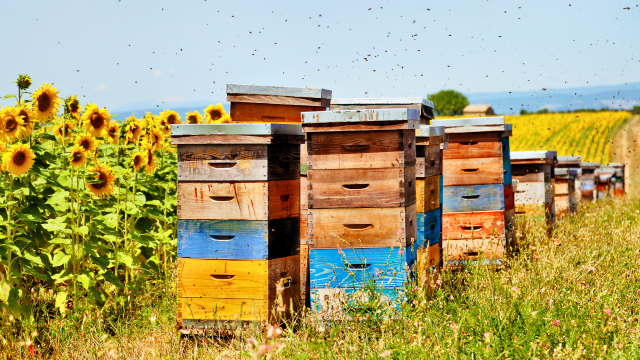
(Beyond Pesticides, May 29, 2026) In a new study published in Environmental Pollution, researchers detected 15 currently used pesticides (CUPs)—including 10 pesticide compounds detected but not applied within the study’s managed fields— in the pollen of beehives in an environment meant to reflect a typical honey bee foraging range.
The detection of pesticides that were not directly applied within the study’s target radius demonstrates the pervasiveness of pesticide drift into soils, streams, and bodies. In this context, public health and environmental advocates continue to call for a wholesale transition to organic land management.
The findings are particularly concerning given the toxicity hazards to honey bees associated with pesticide exposure in this study and bolstered by other studies, resulting in documented threats to their health—as reviewed in this Daily News below.
Methodology and Background
Researchers at the University of Bern and Agroscope, the Swiss government’s agricultural research arm, conducted this research with agricultural land-use data for 2023 and 2024 from the Zurich (provincial/Canton) government. The study area was defined as a 2-kilometer radius around the hive placement site, with 4 active hives over the course of a two-year period (April 10, 2023, through May 3, 2024). The land use within the target site was roughly 42 percent agricultural, 16 percent forestland, 21 percent urban built environment, and 16 percent urban green space. There are detailed pesticide application records available for just 9 percent of the agricultural use area. Five honey bee (Apis mellifera carnica) hives were installed and positioned in Agrocope-managed fields.
To gather samples, pollen traps were set on each hive and activated one per week for a 24-hour period to minimize any colony stressors. Each sample consisted of 2 grams of pollen per colony, which were combined into a single 10-gram pooled sample per week. The goal with this approach is to create a composite sample of exposure across foraging areas and provide sufficient data on site-level pesticide contamination. For more details on the methodology and statistical analysis, please see pages 8-11 of the study PDF.
Out of the 50 target currently-used pesticides (CUPs) screened by the researchers, 15 (or 30 percent) were detected across both sampling seasons, including the neonicotinoid insecticide Acetamiprid, herbicides Prosulfocarb, Terbuthylazine, and fungicides Difenoconazole and Mandipropamid.
The core findings can be broken down into several groups:
- Applied CUPs Detected in Pollen. Acetamiprid is one example of a pesticide detected following applications to rapeseed in both 2023 and 2024. In 2023, it was applied on April 5 and detected in the first available sample (April 28), with concentrations ranging 0.5–3.0 µg/kgdw and declining gradually thereafter. In 2024, concentrations were notably higher (0.6–9.6 µg/kgdw), peaking at 9.6 µg/kgdw on April 26 following a March 15 application. There was no detectable contamination following Acetamiprid applications to potato fields, which is notable given the exposure pathway of pollen at the focus of this study.
- CUPS Detected but not Applied in Agroscope Fields. Ten CUPs were found in pollen despite no application records within the Agroscope-managed fields, suggesting broader contamination and pesticide drift. These include the insecticides Spirodiclofen and Chlorpyrifos, fungicides (Azoxystrobin, Mepanipyrim, Cyprodinil, Trifloxystrobin, Fluopyram, and Fludioxonil), the fungicide metabolite desthio-prothioconazole, and the pesticide synergist Piperonyl butoxide to boost toxicity.
- Persistence Beyond Application Periods. Acetamiprid was detected in samples for several weeks after pre-flowering application, challenging the toxic regulatory status quo that permits the application of insecticides before flowering based on the purported claim that it adequately protects pollinators.
- Off-Target Contamination of Non-Crop Fauna. Pesticide residues were detected in the pollen of untreated, non-crop plants within the Agroscope-managed areas, including dandelions, bird cherry, and other wildflowers.
- Pesticides and Climate Change: Seasonal and Meteorological Influences. The 2024 season was notably more humid than the 2023 season, which created conditions that could likely promote fungal disease pressure, in turn leading to further synthetic fungicide applications.
Previous Coverage
The intersection of the climate crisis and pollinator health has never been clearer than in the latest peer-reviewed science. A study of ecotoxicity risk from neonicotinoid insecticides, published in Environmental Chemistry and Ecotoxicology, finds that chemicals in this class of pesticides, particularly Dinotefuron, increase the body temperature of Apis mellifera (European honey bee) and subsequently accelerate the translocation (movement) of contaminants into hives by the honey bees. The research indicates that neonicotinoids affect acetylcholine receptors in the nervous system, leading to an “elevation in octopamine titer [neurotransmitter/hormone] and subsequent increase in the body temperature of honeybees,” the authors report. They continue: “Furthermore, we observed a considerable upregulation [of] the expression of a flight gene flightin in honeybees. This gene accelerates the homing behavior of honeybees and facilitates the rapid and frequent transport of neonicotinoid pesticide-contaminated nectar to the hive.”
In describing their results, the researchers state: “For the first time, we propose that neonicotinoid pesticides accelerate the homing ability of honeybees by affecting their body temperature, which leads to more neonicotinoid pesticides entering the hive and explains the prevalence of neonicotinoids and at higher concentrations in terms of their effects on the honeybee body temperature that enhances homing.” This accelerated movement of neonicotinoid pesticides into honey bee hives heightens the toxicity hazards to honey bee populations. (See Daily News here.)
A study of two pollinator species, honey bees (Apis mellifera) and small carpenter bees (Ceratina calcarata), finds oxidative stress (OX)— an imbalance between antioxidant defenses and excess reactive oxygen molecules (species), or ROS—resulting from exposure to non-living (abiotic) stressors, such as synthetic chemicals, leading to cell damage. Regulatory bodies, including the U.S. Environmental Protection Agency (EPA), do not routinely evaluate oxidative stress as a standalone or required endpoint in standard pesticide registration protocols. In comparing pollinator responses to different pesticides and pest control management practices, the lowest levels of OX are exhibited in organically managed systems, as described in the research published in Physiological Entomology. (See Daily News here.) Another study published in Insects finds threats to Italian honey bees (Apis mellifera ligustica) following exposure to insecticides with contrasting toxicity levels. Both the high-toxicity and low-toxicity compounds impact honey bee gut bacteria and gut microbial composition, showing how even “reduced risk” insecticides can have sublethal effects and jeopardize pollinator health. As the authors point out, “Honey bees depend on a small but highly specialized community of gut bacteria that help them digest food, resist infections, and cope with environmental stress.” (See Daily News here.)
Pesticide contamination is a global threat. A study published last year in Science of The Total Environment reports widespread pesticide contamination collected from beehive monitoring across the European Union (EU). “This study has produced the first EU-wide distribution map of terrestrial pesticide contamination and demonstrates widespread pesticide contamination of EU environments,” the authors write. The study, led by a cohort of citizen-scientists, documents pesticide drift across the European continent. The results found that 188 of the 429 targeted pesticide compounds were detected in noninvasive, in-hive passive samplers (APIStrips) across 27 EU countries between May and August of 2023. This finding emerges at a time when public health and environmental advocates raise concerns about the European Union’s backtracking on commitments to reduce pesticide use by 2030, although the European Commission announced in July 2025 that “the use and risk of chemical pesticides has decreased by 58% by 2023 [from the 2015-2017 reference period], while the use of more hazardous pesticides fell by 27% over the same period.” (See Daily News here.)
The benefits of organic versus chemical-intensive land management have continued to emerge in the latest science. Researchers in Germany and Brazil investigated the biodiversity of agricultural landscapes in organic and non-organic areas in “bee hotels,” finding that there is a positive correlation between organically managed fields and numerous indicators of improved pollinator health, including an “increase in bee abundance, species richness, and diversity.” This study was published in Global Ecology and Conservation. (See Daily News here.) A study of organic tomato agroecosystems with managed and wild bees, published in Apidologie, affirms the importance of protecting natural systems to support organisms that contribute to crop productivity. The study finds that the strategy of introducing social bees, even those native to other nearby areas, to enhance pollination in open-field conditions provides no direct benefits to the crops that are better served by wild bees. In evaluating the addition of Melipona quadrifasciata stingless bees, not native to the study site, for assisted pollination of tomato plants cultivated in open organic fields, the researchers note that “the presence of M. quadrifasciata hives did not influence fruit quality, indicating that wild bees primarily drove pollination benefits.” (See Daily News here.)
Call to Action
To learn more about the science on pesticides and how they impact ecosystem functioning, see What the Science Shows on Biodiversity. Learn more about your potential exposure to toxic pesticides and chemicals in over 90 non-organic crops, vegetables, fruits, nuts, and related items in the Eating With a Conscience database.
You can also take action by telling EPA, FDA, and Congress that regulations must consider the effects of pesticides in the context in which they are used and with reference to the organic alternative.
All unattributed positions and opinions in this piece are those of Beyond Pesticides.
Source: Environmental Pollution