


22
Jun
#PollinatorWeek 2026: Join Beyond Pesticides for a Week of Activities and Actions
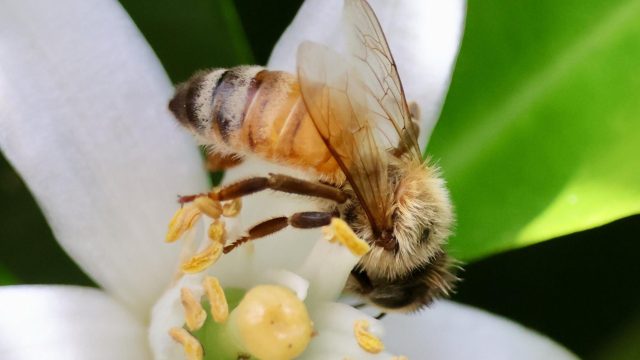
Image: Art of Life Page submission from Jesse Yow, “Honeybee Pollinating Citrus Blossom.”
(Beyond Pesticides, June 22, 2026) National Pollinator Week, June 22-26, 2026, celebrates all pollinators and the ecosystem services they provide. With a theme of “Life on a Leaf… From Bloom to Buzz! An Organic Solution for Plants and Pollinators” and in recognition of the importance of pollinators and biodiversity to a healthy environment and healthy people, Beyond Pesticides announces a week of activities and actions!
Pollinators—bees, butterflies, birds, bats, and other organisms—make a critical contribution to plant health, crop productivity, and the preservation of natural resources, but their existence is threatened by pesticide-contaminated habitats! Throughout the week, we will suggest actions that you can take to promote the health of pollinators.
The first step is providing a safe place for pollinators to live, eat, reproduce, and take refuge from predators and adverse weather, which can include establishing pollinator-friendly plants as both habitats and food sources.
Monday—Juneteenth and Environmental Justice
Dr. Martin Luther King Jr. famously stated, “All life is interrelated.” Justice for all people converges with the protection of biodiversity, health, and climate. If we are not protecting the most vulnerable in society, we ultimately adversely affect the entire society because all people are intricately linked through the web of life. By tapping into the power of working together, we can continue to move forward, as Dr. King says to do, in creating a sustainable future for all through implementing environmental justice with the widespread adoption of organic agriculture and land management.
As Pollinator Week follows closely after the celebration of Juneteenth on June 19, now is the time to renew our commitment to environmental justice while seeking the adoption of transformational policies and practices that recognize the urgency to address disproportionate harm inflicted by toxic pesticide use that affect all life. Those fighting for environmental justice understand that the harms inflicted by toxic chemical production, use, and disposal cause disproportionate adverse effects on people of color—from fenceline communities near chemical production plants to the hazardous and inhumane working conditions in agricultural fields, and the siting of toxic waste dumps, resulting in elevated risk factors for Black, Indigenous, and People of Color (BIPOC) from toxic pesticide exposure.
Amid the overwhelming evidence of disproportionate harm from pesticides to people of color in marginalized communities from pesticide exposure that result in deleterious health effects, captured in studies and research spanning decades [and tracked by Beyond Pesticides!], there is a solution that eliminates pesticide dependency and helps to address environmental injustice—organic agriculture, land, and building management. See the 2026 Juneteenth Daily News from Thursday, June 18, 2026, for more information.
What can we do? You can speak up for environmental justice and urge your U.S. Representative and Senators to ensure funding for meaningful programs that aim to protect essential workers who grow our nation’s food, as well as the health of their loved ones. As an example, see our previous Action of the Week: >> Tell Congress to restore funding that protects the health of farmers, farmworkers, and their families.
Tuesday—Cultivating An Organic Safe Haven for Pollinators
As Doug Tallamy, PhD, entomologist, conservationist, and professor at the University of Delaware, says: “Welcome bugs into your yard. You might just save the world.” With pollinators responsible for over 80% of the world’s flowering plants, it’s no wonder we are fighting to protect them. Pollinators are important members of various land ecosystems; therefore, how we manage these ecosystems and landscapes plays a critical role in long-term pollinator health. The expansion of urban, suburban, and agricultural areas reduces pollinator habitat and access to food, while intensive chemical use harms these beneficial organisms. Pesticide applications expose bees, birds, butterflies, and more to acute and sublethal levels of pesticides, which can result in reproductive abnormalities, impaired foraging, and even death. Please see our brief introduction to pollinators here!
If you want to grow your own vegetables/fruits to eat or flowers for pollinators, make sure that your seeds and plants are free from harmful pesticides. Often, seeds and plants in many garden centers across the country are grown from seeds coated with toxic fungicides and bee-harming neonicotinoid pesticides or drenched with them. Ensure a pesticide-free garden by planting organic seeds and plants!
Synthetic fertilizers and chemical pesticides lead to undesirable conditions that restrict water and air movement in the soil. High nitrogen fertilizers can disrupt the nutrient balance, accelerate turf growth, increase the need for mowing, and contribute to thatch buildup. See Spring Into Action for why going organic is beneficial for not only pollinators but all other organisms (including humans!) as well.
Want to plant your own organic garden? Well, Beyond Pesticides offers a guide on how to Grow Your Own Organic Food, including a resource page on steps to take before planting. Find companies and nurseries that grow and distribute organic seeds and plants here: Seed and Plant Directory Brochure.
Have a problem with unwanted plants (e.g., weeds) taking over your yard and garden? Beyond Pesticides’ guide on how to Read Your Weeds allows you to identify weeds in your lawn and suggests nontoxic or least-toxic solutions. Additionally, Beyond Pesticides’ webpage on Ecological Management of Invasive Species is a great resource for weed management. Many plants that are considered weeds have beneficial qualities. Try to develop a tolerance for some weeds in your garden. For instance, clover is considered a typical turf weed, but it thrives in soil with low nitrogen levels, compaction issues, and drought stress. See Taking a Stand on Clover: The benefits of clover to bees, soil biology, and water quality to learn more.
What can we do? Take action, and encourage your community to develop an integrated roadside vegetation management program for roadside management. Cut, girdle, mow, or use grazing animals whenever possible as a mechanical means to eradicate unwanted vegetation. Establish a roadside wildflower program that plants native flower and grass species, especially those that are attractive to bees and other pollinators. Avoid pesticides such as 2,4-D, glyphosate (Roundup), dicamba, picloram, and triclopyr for roadside management so as not to create ecological traps that harm pollinators. Look to our Pesticide Gateway page for more information!
What else can we do? Order a Pesticide-Free Zone sign to showcase your organic yard or garden, share resources with your community, and share photos of pollinators on social media with the hashtags #PollinatorWeek or #ProtectPollinators—then submit them to Beyond Pesticides’ Art of Life Page!
Wednesday—Spread the Buzz
Beyond Pesticides advocates for widespread adoption of organic management practices as a social good and key to protecting pollinators and the environment. We have long sought and encouraged a broadscale marketplace transition to organic practices, local, state, and federal policies that prohibit the use of toxic synthetic pesticides, and a systems-based approach that is protective of health and the environment. (See BEE Protective for more information.)
Since 2006, honey bees and other pollinators, in the U.S. and worldwide, have experienced ongoing and rapid population declines. This continuing crisis threatens the stability of ecosystems, economies, and the food supply: one-third of the food we eat requires pollination, according to the U.S. Department of Agriculture (USDA).
A 2026 study of honey bee colonies in Florida and California, published in Environmental Toxicology and Pharmacology, finds elevated mortality from pesticide residues, including those that have been documented to threaten pollinators. As the authors describe, “While bees die from multiple, often interacting, stressors, here we show single contributors at levels capable of causing acute harm.” The presence of miticides, fungicides, herbicides, and insecticides within the bee colonies, including in the bodies of dying bees, further highlights pesticides as drivers of bee declines. (See more here.)
What can we do? Take Action! The Trump administration’s U.S. Department of Agriculture (USDA) is shutting down its research facilities at Beltsville Agricultural Research Center (BARC) in Beltsville, Maryland. Among those facilities is the Bee Research Laboratory (aka Bee Lab), which conducts research that has been essential in raising issues critical to the health of honey bee colonies, responding to crises, and helping beekeepers maintain an adequate healthy supply of bees for the pollination of crops. The Bee Lab is not the only federal pollinator program to face funding cuts or dismantling. Also facing threats to funding are the U.S. Geological Survey (USGS) Ecosystems Mission Area, which includes the USGS Bee Lab, other USGS research centers, and U.S. Forest Service research stations.
What else can we do? You can play a role in protecting pollinators simply by growing an organic garden with colorful, bee-attractive flowering plants, pledging it as pollinator-friendly, or even organizing your community, schools, or local government to make choices that foster pollinators. Don’t have a garden? Windows and balconies are also great places to feature plants to encourage pollinators to stop by! Backyard trees, gardens, and beekeeping are great ways to support biodiversity and pollinators. Intentionally providing water, food, and forage to pollinators will encourage and boost pollinator populations in your community.
Check out the BEE Protective Habitat Guide, the Do-It-Yourself Biodiversity resource, which offers hints about increasing biodiversity, and the Pollinator-Friendly Seed Directory.
Thursday—Parks for a Sustainable Future—Become an Advocate!
Does your community have a pesticide-free park managed with organic practices? Do you wish it did? The time to take action to protect those parks and create new ones is now!
With Beyond Pesticides’ supporters, including the retailer Natural Grocers in the Midwest and west, the Beyond Pesticides’ Parks for a Sustainable Future program provides in-depth training to assist community land managers in transitioning two public green spaces to organic landscape management, while aiming to provide the knowledge and skills and experience necessary to transition all public areas in a locality to these safer and sustainable practices.
Through this program, Beyond Pesticides has assisted local leaders in converting the following parks and recreational areas exclusively to organic practices. With this program, Beyond Pesticides is currently working with 19 park districts in 12 states. In addition, Beyond Pesticides has worked with dozens of communities to adopt land management policies in jurisdictions of nearly every state in the country. The goal is to create models that show the viability and cost effectiveness of organic management systems that eliminate petrochemical pesticides and fertilizers that contribute to the current health crisis, biodiversity collapse, and the climate emergency.
What can we do? Become a parks advocate! Beyond Pesticides is interested in working with you to encourage your community to transition to organic. Our training program starts small, with two demonstration sites, but often becomes the basis for broader change to land care practices throughout the entire community.
For more information on the program launch, and to learn more about how YOU can bring the Parks for a Sustainable Future Program to a community near you, please contact Rika Gopinath, Community Policy and Action Manager at [email protected]!
What else can we do? Determine whether your state, school, or community has a law or policy governing pesticide usage in and around schools, or on public lands. Find out if, and how well, it is being implemented, and if you do not have a law, call for an organic land care policy in your community. Petition the school and the town parks department to convert the playing fields to organic care and require the grounds maintenance director, and/or contractors, to be trained in organic land care.
Friday—Pollinator Protection Starts with Organic Practices
In light of EPA’s failure to protect pollinators from pesticides, the lives of those essential insects, birds, and mammals are increasingly dependent on state and local laws in the absence of federal programs that are currently being dismantled or severely cut. In particular, bird species are crucially important for preserving biodiversity, as well as providing ecosystem services such as pollination and mosquito management. Protection of birds and their habitats allows for other organisms, including humans, to prosper.
Mosquito season is upon us! Not only is spraying flying mosquitoes the most ineffective way to prevent mosquito problems, but it is also counterproductive because it eliminates some of our most attractive and helpful allies—birds.
While the appetite of purple martins for mosquitoes is well known, most songbirds and hummingbirds eat insects at some stage of their life. Many birds who eat seeds or nectar feed insects to their young, including flying insects that may be bothersome–like mosquitoes or flies. Altogether, birds consume as many as 20 quadrillion individual insects, totaling 400-500 million metric tons, per year.
Mosquito-eating birds incorporate many well-known residents of our communities. They include, for example, wood ducks, phoebes and other flycatchers, bluebirds, cardinals, downy woodpeckers, swallows, swifts, robins, orioles, wrens, great tits, warblers, nuthatches, hummingbirds, red-winged blackbirds, grackles, chickadees, sparrows, nighthawks, and even the much-maligned starlings.
Insectivorous birds are an essential part of global food webs that bring balance to ecological communities, but birds are not the only insectivores to feed on mosquitoes. Animals who contribute to maintaining ecological balance by consuming mosquito larvae and adults include insects, spiders, fish, amphibians, and bats. All are threatened by pesticides.
What can we do? Attract birds to your yard to keep mosquitoes from feasting on you and take local action! >> Tell your Governor and Mayor to ensure ecological management of mosquitoes by eliminating the use of pesticides that threaten mosquito predators.
Since interactions and synergism are the rule, pesticides cannot be evaluated on the basis of single-chemical, single-species tests. They must be evaluated in context—that is, the system of chemical-dependent management of crops, landscapes, and structures must itself be questioned. Fortunately, there is an alternative system—regenerative organic production and land management—that is both successful and a suitable standard of comparison. The only way to truly protect pollinators, insects, birds, and other species, as well as the biosphere as a whole, is to stop the use of toxic pesticides completely. Converting the world’s agricultural systems to organic would have a tremendous positive impact on threatened populations. >>Tell EPA, FDA, and Congress that regulations must consider the effects of pesticides in the context in which they are used and with reference to the organic alternative.
What else can we do? Use safer personal mosquito repellents. (See How To Repel Mosquitoes Safely for more information.) Spread the word to your neighbors on safer mosquito management with Beyond Pesticides’ doorknob hanger, Manage Mosquitoes This Season without Toxic Chemicals.
For additional information and resources, featured Freaky Pollinators & Plants That Attract Them for each day of the week, and both the historical and current science on pollinators and pesticides, see the Pollinator Week 2026 webpage.
Happy Pollinator Week!
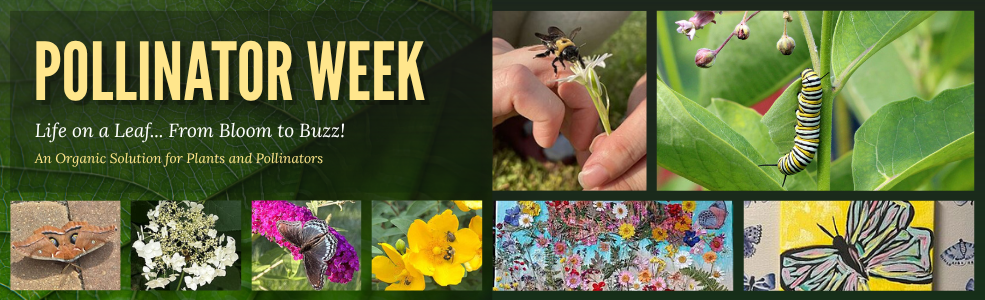
Banner image credits—Featuring the “Art of Life”, from top to bottom and left to right: Sam from Easton, MD, “Oscar, the Bee”; Trix from Petersburg, NY, “Monarch Caterpillar on Common Milkweed”; Evan from Melbourne Beach, FL, “Winged Watcher”; Jocelyn from Contoocook, NH, “Life on a Leaf… Blooms and Buzz!”; Ashley from Oxford, MI, “Butterflies Forever”; Sara from Denton, MD, “Pollen Song”; Janet from Concord, MA, “Spring is Coming”; and, Stephanie from Hamilton, OH, “Butterfly.”
All unattributed positions and opinions in this piece are those of Beyond Pesticides.