


15
Jul
Sea Anemone Critical to Marine Ecosystem Stability Undermined by Pesticide Exposure
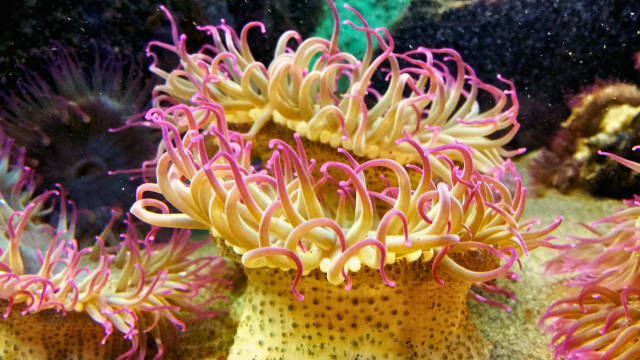
(Beyond Pesticides, July 15, 2026) Researchers at the U.S. Geological Survey and Portland and Oregon State Universities, in a study reported in Marine Pollution Bulletin, find that pesticide exposure, including the herbicide atrazine and fungicide carbendazim, found in combination with the herbicide diuron in the environment, significantly impacts reproductive organ development in sea anemone (Anthopleura elegantissima), an important organism in the marine environment. “Sea anemone [is] any member of the invertebrate order Actiniaria (class Anthozoa, phylum Cnidaria), soft-bodied, primarily sedentary marine animals resembling flowers,” according to the Encyclopedia Britannica.
According to the Convention on Biological Diversity, marine ecosystems store about 15 times more carbon emissions than terrestrial and soil ecosystems, while “oceans represent 95 percent of the [planet’s] biosphere.” Sea anemones are critical to protecting marine biodiversity by acting like microhabitats for small invertebrates such as opalescent nudibranchs and amphipods (beneficial crustaceans), serving as a food source for marine predators including sea stars and slugs, contributing to nutrient cycling by consuming passing crustaceans, among other benefits. (See here, here, here, and here.)
For example, sea anemones provide protection and nutrients to Red Sea clownfish (Amphiprion bicinctus), and in return these fish offer a nature-based solution to ventilation, nitrogen, and carbon to the host and its endosymbiotic zooxanthellae that researchers state is, at least in the context of nitrogen, “provide essentially the same level of physiological contribution” as synthetic nitrogen supplements. (See here.) The health of endosymbiotic zooxanthellae is critical in providing energy to their host species, including both sea anemones and coral reefs. (See here.) Sea anemones also provide habitat for diverse shrimp species (see here) and more broadly serve as a foundational species/facilitator for numerous dependent organisms. (See here and here).
This research builds on prior scientific analyses and findings that indicate the extent to which agrichemicals undermine keystone marine species and their ecosystems. In this context, public health and environmental advocates call for a transition to organic land management in response to the science on the adverse effects of petrochemical pesticides, documented deficiencies in the pesticide regulatory system, and multinational corporate influence, as evidenced by the U.S. Supreme Court decision in Monsanto v. Durnell (June 2026). See Daily News, Supreme Court Gives Pesticide Makers Immunity from Litigation for Omitting Cancer Warning on Products.
Methodology and Main Findings
The researchers conducted an 8-week experiment in a laboratory setting, exposing 288 sea anemones to three pesticides detected in Oregon coastal waters—atrazine, carbendazim, and diuron. The anemones were collected from four colonies (two male and two female) in June, during a period when the organisms begin major development of reproductive organs.
The study applied six pesticide treatments with four replicate tanks: control, atrazine alone, diuron alone, diuron and carbendazim, and a mixture of all three pesticides. The researchers focused on the diuron/carbendazim combination due to comparatively limited research on their impacts on marine invertebrates. In terms of dosing, pesticides were applied every 10 days following the changing of 20 percent of the water. In terms of pesticide concentrations, all of the tank concentrations are below chronic aquatic life benchmarks, as defined by the U.S. Environmental Protection Agency (EPA), due to solubility difficulties and human error. For further information on statistical analysis, please see Section 2.7 on page 5 of the study PDF.
The main findings fall into the following categories:
- Reproductive and Gonad Development. All pesticide treatments in this study significantly lowered gonad index (proxy variable for reproductive health) relative to the control tank, thus threatening long-term survival of the species. Diuron was the only treatment to have a marginal impact.
- Individual and Mixture Results. According to the study, “Pesticides significantly decreased gonad development in all treatments, having the most significant effect in individual treatments of atrazine, carbendazim, and the mixture of all three pesticides.”
- Mortality Attributed to Carbendazim Exposure. While the mortality rate was overall low relative to the total number of sea anemones (less than 2 percent, 5/288 mortalities). The authors attribute two of the deaths to carbendazim given that they took place in different tanks and colonies. This is a secondary finding for a study focused
Previous Coverage
There is an array of scientific literature documenting the pervasiveness of pesticide exposure in waterways and marine ecosystems, as well as adverse health effects on aquatic organisms.
In a literature review published in Caspian Journal of Environmental Sciences, researchers assess 27 peer-reviewed studies conducted between 2011 and 2025 on the adverse impacts of insecticides, including neonicotinoids, pyrethroids, organophosphates, chlorpyrifos, and fipronil. Across agricultural and suburban environments, pesticides are detected in the majority (88 percent) of samples across the selected studies. (See Daily News here.)
A global literature review of pesticide residues in marine seaweed, published in Marine Pollution Bulletin, highlights the widespread presence of pesticides in bioindicator species. As vital coastal primary producers, seaweed acts as a key indicator for regional pesticide contamination patterns. The bioaccumulation within seaweed species also threatens consumers, including humans, as the chemicals can biomagnify as they move through the food web. In addition to the support seaweed provides for ecosystems, they provide food sources for a multitude of organisms and is of growing socioeconomic importance. “This systematic review identifies, critically evaluates, and synthesizes recent global literature (2015–2024) on pesticide residues detected in seaweeds to delineate contamination patterns,” the authors state. The findings highlight the harmful impacts of petrochemical pesticides on multiple species. Many aquatic species rely on seaweed as a food source, including fish, sea urchins, crabs, snails, brittle stars, and marine mammals such as manatees and sea turtles. Even bacteria and filter feeders consume seaweed when it is decomposed. Birds and land mammals also consume seaweed, including humans who utilize seaweed in various food products due to its high nutritional value. (See Daily News here.) Documented for the first time, 15 currently used pesticides (CUPs) and four metabolites (breakdown or transformation products—TP) are found in the marine atmosphere over the Atlantic Ocean. Three legacy (banned) pesticides were also discovered. According to a recent study published in Environmental Pollution, researchers found empirical evidence for pesticide drift over remarkably long distances to remote environments. (See Daily News here.)
Legacy pesticide exposure continues to pollute, and ultimately undermine, ecosystem stability. A study in Environmental Science and Technology Letters, funded by the National Oceanic and Atmospheric Administration, is the first to find halogenated organic compounds (HOCs) in deep ocean sediment and biota off the coast of California. The test area, known as the Southern California Bight (SCB), is home to historic offshore DDT waste dumping, with part of the SCB designated as a U.S. Environmental Protection Agency (EPA) Superfund site. 49 HOCs were detected in the sediment and biota, many of which are DDT-related and not previously screened for. The presence of these “unmonitored compounds can significantly contribute to the contaminant body burden across a range of marine taxa,” the study states. (See Daily News here.)
A study of pesticide-contaminated algae finds that the disruption of algal communities has a devastating effect on the health of the aquatic food web. The study findings show that contact with pesticides can result in changes to “algal physiology, causing tissue injury, developmental delay, genotoxicity, procreative disruption, and tissue biomagnification” that alters the dominance of algae species in the environment. This in turn “can impact higher trophic levels and have a domino effect on the aquatic food web. It is possible for biodiversity to disappear, reducing ecosystem stability and resistance to environmental alterations,” the authors state. The study, a worldwide literature review conducted by researchers from India, South Korea, and Saudi Arabia, appears in Aquatic Toxicology. (See Daily News here.)
In a study published in Aquatic Toxicology, researchers in Brazil determined that the cumulative toxicity of acetamiprid (a neonicotinoid insecticide) and cyanobacteria (photosynthetic microbes that can produce toxins) has a synergistic effect on the health of aquatic water fleas, or Daphnia. These findings paint a troubling picture for broader aquatic food webs, since they serve as a bridge species across trophic levels—being a primary consumer of plants and algae while also providing energy to secondary and tertiary consumers up the chain. The goal of this study is to examine the chronic impacts of singular and cumulative toxicity of acetamiprid and elevated levels of cyanobacterium (Raphidiopsis raciborskii strain LETC-CY-05), which is known to produce saxitoxin—a toxin that can contribute to “red tide” algal blooms, disrupting entire aquatic ecosystems if not properly managed. (See Daily News here.)
Toxic pesticides are also harming coral reefs. Large benthic foraminifera (LBF) are single-celled organisms found on reefs that face adverse metabolic impacts after exposure to the weed killer glyphosate, fungicide tebuconazole, and insecticide imidacloprid, according to a study published in Marine Pollution Bulletin. The study found that “even the lowest doses of the fungicide and herbicide caused irreparable damage to the foraminifera and their symbionts.” Beyond Pesticides reiterates our mission of banning toxic petrochemical pesticides by 2032, and that this goal applies to land and water exposure to pesticides. LBFs are typically used as bioindicators for coral health because they are found in substantial quantities and gathering data is not intrusive or damaging to reef health. (See Daily News here.)
Call to Action
Subscribe to receive the Action of the Week and Weekly News Update in your inbox so that you can take strategic actions calling for change from the local to international.
To learn more on how to take action in the aftermath of Monsanto v. Durnell, please consult the following resource: Require Pesticide Product Manufacturers To Provide Warning Labels of Potential Effects like Cancer.
All unattributed positions and opinions in this piece are those of Beyond Pesticides.
Source: Marine Pollution Bulletin