


16
Jul
If Done Right, Flower Strips and Legume Crops Offer Pesticide-Free Pest Management
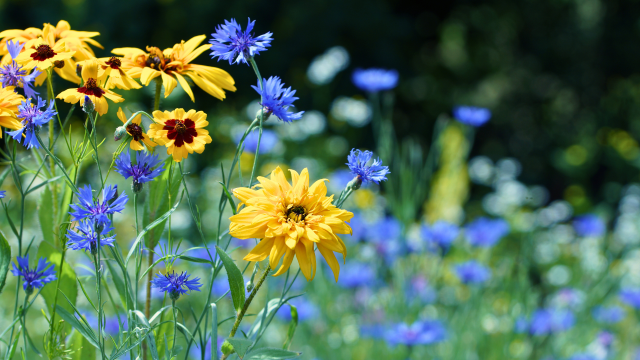
(Beyond Pesticides, July 16, 2026) In a study published in the British Ecological Society, researchers in Germany determined that flower strips and legume mixtures hold statistically significant benefits in terms of natural pest control. This comes as no surprise to organic farmers and landscapers, as well as public health and environmental advocates, who have witnessed the impact of transitioning to organic, regenerative, and agroecological land management practices and systems on the grounds of public health, biodiversity, and climate resilience.
As part of the methodology to determine the contribution of flowering strips to insect management, “The area between the flowering strips received no insecticides, while the remaining outer part of the fields was treated according to usual farm management practices.”
Presumably this offered some control for contamination from neighboring fields treated with pesticides, which in other studies have been shown to result in harm to ecosystem services for managing insects.
Methodology and Main Findings
The researchers conducted a replicated, randomized experimental design for this study methodology, based on 10 commercial sugar beet fields during the 2021 to 2022 season. The fields consisted of 5.8 hectares (ha) to 26 ha (approximately 14 to 64 acres, with a field size of 12.8 ha (or 31 acres). The fields were in three regions of Germany—six in Cologne-Bonn, two in the Lower Rhine, and two in southern Lower Saxony.
Each field consisted of three flower strips measuring 178 to 428 meters long and 6 meters wide; each flower strip, or “band” as the authors refer to them colloquially, was sown with one of five flower mixtures in five randomly divided segments of at least 30 meters. Two control areas were established alongside each strip: an untreated (no pesticide) area (INS-) and an insecticide-treated area (INS+). The flower strips were sown ahead of beet sowing in the following spring. Researchers state that no pesticides or fertilizers were applied within the flower strips, with areas between strips not sprayed with insecticides.
It is important to note that the exterior part of the field engaged in “conventional” management, which appears to signal that they were managed in a chemical-intensive manner. This could have impacted the results of this study.
There were four different types of flower strips, with three of the four building on a common basic mixture (BASE) including 35 percent common marigold, 25 percent cornflower, 25 percent red poppy, and 15 percent red clover. LEG strips incorporated the Fabaceae plant family, API added the Apiaceae family, and AST included the Asteraceae family. There was also a fifth “flower strip” treatment that included faba beans (BEAN), given the researcher’s hypothesis that they may “attract specialist natural enemies.” Plants were counted in one square meter squares in March 2022 to establish overwintering success and between May and June 2022 for flowering success. Researchers define “success” as one plant identified per band. Aphids on sugar beet plants were counted on a biweekly basis, with an average of five recordings on each of the 10 sites. Other plants were inspected adjacent to the two control fields as well. Through pitfall traps set within the band and three meters from all three bands and five mixtures described above, natural enemies were sampled on a biweekly basis between May 12 and June 9, 2022. After May 5, sampling was reduced to two bands per site for eight sites. Aphid predators were organized into Arachnida, Carabidae, Staphylinidae, Coccinellidae, Syrphidae, and Chrysopidae. Beneficial arthropods (Araneae, Cantharidae, coccinellid larvae/pupae/adults, Coleoptera, Heteroptera, parasitoid wasps, and syrphid larvae/adults) were captured on the beet plants using waterproof cameras. The yield of each site was measured between September 5 and 20, 2022; after accounting for human error, the final yield had 41 data points.
The main findings include the following:
- BEAN, LEG, & AST Significantly Reduced Black Aphids. Relative to untreated control fields, fields grown with faba beans or flower mixtures including the Asteraceae and Fabaceae plant families were shown to dramatically lower black aphid count.
- Flower and Legume Mixtures Impact Declines with Distance from Crops. For the basic mixture (BASE) and faba bean treatment (BEAN), the researchers proved their distance-decay hypothesis.
- Significant Relationship Between Beneficial Arthropod Abundance and Slower Aphid Population Growth. While only significant on four of the ten sites, researchers found “Aphid population growth declined significantly with increasing beneficial insect abundance.”
- Insecticides vs. Flower Strips Negligible Effect on Yields. “Our results demonstrate that replacing insecticides with flowering strips had no significant effect on sugar beet yield.” The researchers cite two sources (see here and here) identifying evidence of increased yields on fields with flower strips.
Previous Coverage
In a study published in Agriculture, Ecosystems & Environment, researchers from France find pesticide-free fields promote carabid beetles and spiders, generalist arthropod predators that consume slugs, aphids, and mites, that in turn support healthy, organic systems. The study findings highlight the importance of utilizing farming practices that promote biodiversity and foster natural enemy populations as a pest management strategy. “In this study, we assessed the assemblages of emerging and circulating ground-dwelling carabids and spiders during four months in a continuous mosaic of pesticide-free winter-sown crops under contrasted tillage regimes (minimum vs. conventional tillage) and sown flower strips bordering fields,” the authors describe. They continue: “We detected clear patterns, with high in-field carabid and spider overwintering densities than in adjacent flower strips… Our results also demonstrate the key role of pesticide-free fields under minimum tillage, acting both as a high-quality overwintering site for some dominant carabid species and as a source habitat, as several predator species activity-density responded positively to the increased area of minimum tillage fields in the surroundings.” (See Daily News here.)
Organically managed flower strips make pollinators thrive in agricultural systems. In a study, German researchers compared 16 agricultural landscapes in Lower Saxony and northern Hesse that had different combinations of semi-natural habitat, organic practices, and annual and perennial flower strips. Overall, the researchers found that organic farming provides the highest benefit to the bees, along with the presence of diverse flowering plants in and near monoculture fields. The study compares the effects of three honey bee conservation methods on the prevalence of the parasitic mite Varroa destructor and the 11 parasites Varroa transfers to bees, and the impact of these destructive organisms on bee colony growth. The findings were reported in the Journal of Applied Ecology. The authors note that their results support the European Union’s Green Deal, which aims to reach 25% organic agriculture in Europe by 2030. (See Daily News here.) Please see the following Daily News for additional research on the impacts of organic versus non-organic farmland on honeybee health, Study Highlights Benefits of Organic Agriculture for Pollinator Health, Building on Existing Research.
Numerous publications have highlighted the benefits of incorporating legumes into intercropping and multicropping organic fields. In the Journal of Environmental Quality, researchers at the U.S. Department of Agriculture (USDA) report that a 4-year organically managed corn-soybean-oat system reduces nitrogen (N) loads by 50 percent with corn and soybean yields “equivalent to or higher than conventional [chemical-intensive] in most years.” The findings from a 7-year study comparing nitrate loss in organic and chemical-intensive management found that organically managed perennial pasture reduced nitrogen loads significantly. The study, which focused on nitrate pollution in agriculture that harms biodiversity, threatens waterways, drinking water, and public health, and releases nitrous oxide (an extremely potent greenhouse gas), was conducted at USDA’s National Laboratory for Agriculture and the Environment. (See Daily News here.)
A study published in Scientific Reports highlights the benefits of organic agriculture in comparison to different farming systems over five years on four crops (maize, tomato, faba bean, and potato). For example, regarding crop yield, and due to the improvement of soil properties with organic methods, the highest yield after the fifth season was with organic systems. “The maize yield increased by 6.97, 30.92 and 21.79% for conventional, organic and biodynamic, respectively, after five years,” the researchers report. They continue: “The tomato yield increased by 21.37, 65.89 and 54.48% for conventional, organic and biodynamic, respectively, while the faba bean yield increased by 30.47, 51.69 and 31.96% for conventional, organic and biodynamic, respectively, and the potato yield increased by 27.19, 38.50 and 44.85% for conventional, organic and biodynamic, respectively.” These results agree with previous findings as well. (See studies here, here, and here.) (See Daily News here.)
In the first session of the Beyond Pesticides 42nd National Forum, The Pesticide Threat to Environmental Health: Advancing Holistic Solutions Aligned with Nature (see here for recording), expert researchers convened to discuss their research and implications for the cost savings associated with ecological pest management, including Danilo Russo, PhD, professor of ecology at the University of Naples Federico II, international leader in bat research, and coauthor of A Natural History of Bat Foraging: Evolution, Physiology, Ecology, Behavior, and Conservation. Dr. Russo has authored additional publications on the intersection of bat conservation and farmland protection in recent years that build on this sentiment. For example, a research study published in Agriculture, Ecosystems and Environment (2023) explores the concept of “bat-friendly” agricultural systems as an “ecological trap”—in other words, anthropogenic climate change can so fundamentally change the structure of ecosystems that wildlife (from bats to bears and everything in between) no longer can adequately “ assess habitat quality, luring them to poor habitats and reducing individual fitness.” This study examines European farmland and obstacles for habitat restoration for at-risk bat species on and bordering agricultural sites, with “the persistent and widespread use of pesticides” noted as a primary threat to ongoing and future conservation efforts. Organic farming is referenced as a mitigation strategy/solution as opposed to bat conservation areas being established near pesticide use. The authors write, “Luring bats to agricultural sites highly contaminated with pesticides or where they may encounter ecological traps associated with infrastructures could have detrimental impacts on a broad scale.” (See Daily News here.)
Call to Action
For more peer-reviewed science on biodiversity impacts of synthetic and organic pest management, please visit What the Science Shows on Biodiversity.
You can all subscribe to receive the Action of the Week and Weekly News Update in your inbox so that you can take strategic actions calling for change from the local to international.
All unattributed positions and opinions in this piece are those of Beyond Pesticides.
Source: British Ecological Society