



.png)
Triclosan
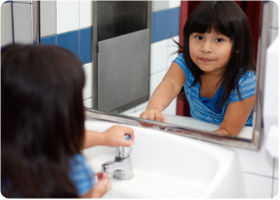 Triclosan, one of the most prevalent antibacterial compounds found in products, is the focus of a campaign undertaken by a coalition of health and environmental groups led by Beyond Pesticides and Food & Water Watch, aimed at removing triclosan from the market. Over the last few years, as a direct result of pressure from consumer groups and the media regarding the need for triclosan in consumer products and the mounting scientific evidence documenting adverse health effects, including impacts to the thyroid hormone, major manufacturers have quietly reformulated their products without triclosan.
Studies have increasingly linked triclosan (and its chemical cousin triclocarban), to a range of adverse health and environmental effects from skin irritation, endocrine disruption, bacterial and compounded antibiotic resistance, to the contamination of water and its negative impact on fragile aquatic ecosystems.
When introduced to the market in 1972, triclosan was confined to hospital and health care settings. Since then triclosan exploded onto the market place in hundreds of consumer products ranging from antibacterial soaps, deodorants, toothpastes, cosmetics, fabrics, toys, and other household and personal care products. Triclosan’s success on the consumer market has been aided by the false public perception that antibacterial products are best to protect and safeguard against potential harmful bacteria. However, an article in the journal Clinical Infectious Diseases, entitled "Consumer Antibacterial Soaps: Effective or Just Risky?" (2007), concludes that antibacterial soaps show no health benefits over plain soaps. In 2010, FDA stated that, “Existing data raise valid concerns about the [health] effects of repetitive daily human exposure to [triclosan]” and announced plans to address the use of triclosan in cosmetics or other products.
See a list of common products containing triclosan.
Recent Updates
- Minnesota Bans Triclosan in Consumer Personal Care Cleaning Products
Triclosan has been banned from consumer personal care cleaning products in the state of Minnesota by an act of the state legislature. This public health measure, SF 2192, states that “no person shall offer for retail sale in Minnesota any cleaning product that that contains triclosan and is used by consumers for sanitizing or hand and body cleansing.” The legislation takes effect on January 1, 2017. One of the legislation’s lead sponsors, state Senator John Marty, predicted that the odds are good that most manufacturers will phase out triclosan by then as a result of this effort and other marketplace pressure. For More information see Beyond Pesticides' press release. -
FDA Will Require Manufacturers to Prove Safety and Efficacy of Antibacterial Products; Beyond Pesticdes' Press Release
December 2013 - A new rule proposed by the U.S. Food and Drug Administration (FDA) will now require manufacturers of antibacterial hand soaps, body washes, and other consumer goods to prove that their products are both safe for long-term use and more effective than regular bar soap in order to remain on the market. This announcement, though long delayed, represents a positive step towards reining in the unnecessary use of antibacterial chemicals.FDA’s new rule, announced Monday, will be open for public comment for 180 days and manufacturers will have one year to submit new data on their products. FDA hopes to finalize its rule and determine whether antibacterial products can be “generally recognized as safe” (GRAS) by September 2016. Read FDA's Consumer Update.
Let Yor voice be heard on these new proposed rules! The agency is accepting public comments until June 16, 2014. Submit your comment here. - Proctor & Gamble To Eliminate Triclosan From its Products by 2014
September 2013- Multinational manufacturer Procter and Gamble (P&G) announced that it will eliminate the harmful antibacterial chemical triclosan from its products by 2014. P&G’s notice is the latest in a growing trend across the county, as both governments and private companies continue to move away from the use this dangerous and unnecessary substance. While P&G does not name the specific products from which it will be removing triclosan, it notes that the only remaining uses of triclosan are in the company’s antibacterial dish soap, professional hand soap, and some other personal care products (brands like Dawn and Safeguard Antibacterial Soaps). - Minnesota State Agencies to Stop Procurement of Triclosan
The Minnesota Pollution Control Agency announced on March 3, 2013 that state agencies have been ordered by Governor Mark Dayton to stop buying products that contain triclosan, a synthetic, broad-spectrum antimicrobial agent that has become ubiquitous in consumer products ranging from face-washes to fabrics. This ban, which will go into effect in June, comes as the debate over the efficacy and necessity of triclosan intensifies in the Minnesota State legislature. A bill banning triclosan’s use outside of medical settings is expected to be introduced, and the legislature conducted a hearing Tuesday on the possible human health and environmental consequences of the chemical. - It is time once again to tell EPA to remove this dangerous chemical from the market.
In March 2013, EPA opened the federal docket for triclosan, offically beginning the registration review of triclosan. Under pressure after its 2008 review, EPA announced that it would again review triclosan in 2013, five years earlier than scheduled. Over the last few years, as a direct result of pressure from consumer groups and the media regarding the need for triclosan in consumer products and the mounting scientific evidence documenting adverse health effects, including impacts to the thyroid hormone, major manufacturers have begun to quietly reformulate their products without triclosan. - Johnson & Johnson to Phase Out Triclosan. Health care and cosmetics giant Johnson and Johnson has announced that it will soon begin phasing out a number of potentially dangerous chemicals from its personal care brands, including triclosan. The company cites consumer concern over the safety of triclosan as among its reasons for the alteration in its products, hinting that it was uncomfortable with growing body of science linking triclosan to a number of health concerns. The phase out is scheduled to be complete by the end of 2015.
- Canada Declares Triclsoan Toxic to the Environment. The Canadian government declared triclosan toxic to the environment, a move which would see the use of the chemical curtailed sharply in Canada. The draft risk assessment found triclosan to be toxic to the environment but did not find enough evidence to say it is hazardous to human health. A toxic designation under the Canadian Environmental Protection Act triggers a process to find ways to curtail a chemical’s use, including a possible ban in a range of personal-care products.
- Issac Pessah at Beyond Pesticides 31st National Pesticide Forum. In 2012, researchers from the University of California at Davis (UC Davis) and the University of Colorado found that triclosan impairs muscle function in fish and mice and stated that the results they found show “strong evidence that triclosan could have effects on animal and human health at current levels of exposure.” Issac Pessah, Ph.D., co-author of the muscle function study and chair of the Department of Molecular Biosciences at UC Davis spoke at Beyond Pesticides 31st National Pesticide Forum. His talk in its entirety can be viewed here.
- From PRI: Triclosan Safety Questioned. Public Radio International's Living on Earth (download the show) recently interviewed Beyond Pesticides about the toxic antibacterial agent triclosan, which is found in many consumer products like toothpaste, countertops and children’s toys. The Food and Drug Administration (FDA) was also interviewed.
Resources
- Sign the Pledge. Join the campaign to end the consumer use of triclosan.
- Triclosan Model Resolution. Get your municipality, institution or company to adopt this resolution to not buy products with triclosan and supporting broader elimination of non-medical uses.
- Regulatory and Policy. The latest information and history on legal procedures to ban consumer uses of triclosan.
- Find triclosan-free products from a list of companies who have already signed the pledge to be triclosan-free.
- Factsheets:
- Triclosan: Managing Germs Without This Hazardous Antibacterial Pesticide (February 2011)
- What's the Right Answer to the Germ Question? As children go back to school, protect them from germs without using hazardous chemicals in lunch bags,soaps and sanitizers. (August 2009)
- What’s Lurking in Your Soap? The Trouble with Triclosan. Beyond Pesticides and Food & Water Watch (March 2009)
- Triclosan: What the Research Shows. Beyond Pesticides and Food & Water Watch (March 2009)
- Beyond Pesticides Triclosan Factsheet. (October 2004)
- Triclosan Hazards...Continued. Trade group misleads on common antibacterial agent. (January 2005)
- Other online resources.
Update Archives
- Beyond Pesticides, Center for Environmental Health and Campaign for Safe Cosmetics urges Bath and Body Works to stop selling Triclosan products. With flavors like “tangelo orange twist,” and “sugar lemon fizz,” popular body care chain, Bath and Body Works, has marketed an entire line of antibacterial body care products to teens and young adults. Unfortunately, these products contain the toxic hormone disruptor and water contaminant, triclosan, which could be hazardous to teenagers whose bodies are still developing. Join us in asking Bath and Body Works to stop selling triclosan products that claim to “Spread Love, Not Germs.”
- Overwhelming support for the petition to ban Triclosan. Over 10,000 individuals told EPA, via email and docketed comments, to ban the dangerous antibacterial triclosan. Additionally, scores of public health and advocacy groups, local state departments of health and the environment, as well as municipal and national wastewater treatment agencies submitted comments requesting an end to triclosan in consumer products. EPA published the petition for public comment in December 2010 and closed the comment period on April 8, 2011. Beyond Pesticides once again urged the agency to ban the uses of triclosan in consumer products citing risks to human and environmental health.
- Act by April 8, 2011. Let EPA know that it's time to ban triclosan. EPA has extended the comment period for another 60 days to April 8, 2011.Your voice is critical in generating public comments on a petition, published in the Federal Register, to ban the antibacterial chemical triclosan. As you may know, this chemical, now found in the bodies of 75% of the US population, is linked to endocrine disruption, bacterial and antibiotic resistance, dioxin contamination, and contaminated fish and biosolids.
- Send an email directly to EPA Administrator Lisa Jackson or;
- Submit your own comments to the docket directly by clicking here. Fill in the form to submit your comments to the Federal Register (this method offers different levels of privacy). For a more impactful statement, use your own language.
- EPA publishes petition to ban Triclosan for public comment
- EPA announced a 60-day public comment period for the petition filed by Beyond Pesticides and Food and Water Watch to ban the controversial antimicrobial pesticide triclosan for non-medical use. The petition, filed on January 14, 2010, identifies pervasive and widespread use of triclosan and the agency's failure to address triclosan's impacts on human and environmental health, conduct assessments for residues in drinking water and food and concerns related to antibacterial resistance and endocrine disruption. The petition cites various violations of numerous environmental statues including the Clean Water Act, Safe Drinking Water Act and the Endangered Species Act.
- Comments are accepted until April 8, 2011 at www.regulations.gov. Direct comments to docket number: EPA–HQ–OPP–2010–0548. When commenting, please specify the statute to which your comments refer (FIFRA, FFDCA, SDWA, CWA, or ESA) and the specific issue(s) raised in the petition regarding that statute on which you are commenting. (December, 2010)
- Congresswoman Urges FDA to Ban Triclosan. House Rules Committee Chairwoman Louise M. Slaughter and two colleagues asked the U.S. Food and Drug Administration (FDA) to ban triclosan due to the hazards that this chemical poses, including antibiotic resistance and potentially leading to higher health care costs, citing both Beyond Pesticides and Food and Water Watch's petition currently pending before the agency (November 2010).
- Newly released data from the Centers for Disease Control and Prevention (CDC) finds that levels of triclosan in humans have increased by 50% since 2004 (August 2010).
- Beyond Pesticides tells FDA that Triclosan is too hazardous to the aquatic environment. In response to the agency's request for environmental data regarding tricosan's use in certain over the counter products, Beyond Pesticides and others reminded the agency that it must recognize that significant adverse environmental impacts will occur with continued triclosan use (May 2010).
- FDA says, "existing data raise valid concerns" regarding exposure to triclosan. FDA is considering action in light of a petition submitted by Beyond Pesticides, and others, and in response to a letter from Rep. Markey (April 2010).
- Beyond Pesticides, Food & Water Watch and more than 80 organizations petitioned EPA to ban triclosan for non-medical applications on the basis that uses violate federal laws regulating pesticides, clean and safe drinking water, and endangered species (January 2010).
- Looking for a product free of triclosan? Find one from a list of companies that have signed the pledge to be triclosan-free.
- Take Action! Learn how you can help end the unnecessary use of this toxic antibacterial chemical. Stay in the loop on triclosan and other issues by joining us on Facebook.