

26
Nov
A Giving of Thanks, From Beyond Pesticides to You
(Beyond Pesticides, November 26-30, 2025) The Beyond Pesticides team and board would like to thank those working in communities across the country and actively working to protect the health of our soil, air, water, and all life.
In the spirit of uplifting the intersection of traditional ecological knowledge and science, we would like to share with you some excerpts from Braiding Sweetgrass: Indigenous Wisdom, Scientific Knowledge and the Teachings of Plants—a collection of essays written by Robin Wall Kimmerer, PhD, founder and director of the Center for Native Peoples and the Environment, professor of environmental biology at the State University of New York (SUNY) College of Environmental Science and Forestry (ESF) in Syracuse, New York, mother, and enrolled member of the Citizen Potawatomi Nation.
As you read these excerpts, we hope that they offer a sense of empowerment to take actions that protect the natural world and advance organic land management systems that respect the ecosystems that support life.

The Gift of Reciprocity
Know the ways of the ones who take care of you, so that you may take care of them.
Introduce yourself. Be accountable as the one who comes asking for life. Ask permission before taking. Abide by the answer.
Never take the first. Never take the last. Take only what you need.
Take only that which is given.
Never take more than half. Leave some for others. Harvest in a way that minimizes harm.
Use it respectfully. Never waste what you have taken. Share.
Give thanks for what you have been given.
Give a gift, in reciprocity for what you have taken.
Sustain the ones who sustain you and the earth will last forever.
Each person, human or no, is bound to every other in a reciprocal relationship. Just as all beings have a duty to me, I have a duty to them. If an animal gives its life to feed me, I am in turn bound to support its life. If I receive a stream’s gift of pure water, then I am responsible for returning a gift in kind. An integral part of a human’s education is to know those duties and how to perform them.
If all the world is a commodity, how poor we grow. When all the world is a gift in motion, how wealthy become.
Lessons from Nature
Sometimes I wish I could photosynthesize so that just by being, just by shimmering at the meadow’s edge or floating lazily on a pond, I could be doing the work of the world while standing silent in the sun.”
Being naturalized to place means to live as if this is the land that feeds you, as if these are the streams from which you drink, that build your body and fill your spirit. To become naturalized is to know that your ancestors lie in this ground. Here you will give your gifts and meet your responsibilities. To become naturalized is to live as if your children’s future matters, to take care of the land as if our lives and the lives of all our relatives depend on it. Because they do.
The trees act not as individuals, but somehow as a collective. Exactly how they do this, we don’t yet know. But what we see is the power of unity. What happens to one happens to us all. We can starve together or feast together.
Power of Community and Space
To love a place is not enough. We must find ways to heal it.
We need acts of restoration, not only for polluted waters and degraded lands, but also for our relationship to the world. We need to restore honor to the way we live, so that when we walk through the world we don’t have to avert our eyes with shame, so that we can hold our heads up high and receive the respectful acknowledgment of the rest of the earth’s beings.
We Americans are reluctant to learn a foreign language of our own species, let alone another species. But imagine the possibilities. Imagine the access we would have to different perspectives, the things we might see through other eyes, the wisdom that surrounds us. We don’t have to figure out everything by ourselves: there are intelligences other than our own, teachers all around us. Imagine how much less lonely the world would be.
Philosophers call this state of isolation and disconnection “species loneliness”—a deep, unnamed sadness stemming from estrangement from the rest of Creation, from the loss of relationship. As our human dominance of the world has grown, we have become more isolated, more lonely when we can no longer call out to our neighbors. It’s no wonder that naming was the first job the Creator gave Nanabozho.
Centering Indigenous Knowledge and the Power of Language
In the Western tradition there is a recognized hierarchy of beings, with, of course, the human being on top—the pinnacle of evolution, the darling of Creation—and the plants at the bottom. But in Native ways of knowing, human people are often referred to as “the younger brothers of Creation.” We say that humans have the least experience with how to live and thus the most to learn—we must look to our teachers among the other species for guidance. Their wisdom is apparent in the way that they live. They teach us by example. They’ve been on the earth far longer than we have been, and have had time to figure things out.
A bay is a noun only if water is dead. When bay is a noun, it is defined by humans, trapped between its shores and contained by the word. But the verb wiikwegamaa—to be a bay—releases the water from bondage and lets it live. ‘To be a bay’ holds the wonder that, for this moment, the living water has decided to shelter itself between these shores, conversing with cedar roots and a flock of baby mergansers. Because it could do otherwise—become a stream or an ocean or a waterfall, and there are verbs for that, too. To be a hill, to be a sandy beach, to be a Saturday, all are possible verbs in a world where everything is alive. Water, land, and even a day, the language a mirror for seeing the animacy of the world, the life that pulses through all things, through pines and nuthatches and mushrooms. This is the language I hear in the woods; this is the language that lets us speak of what wells up all around us.[…]
This is the grammar of animacy.
 All unattributed positions and opinions in this piece are those of Beyond Pesticides.
Call to Action
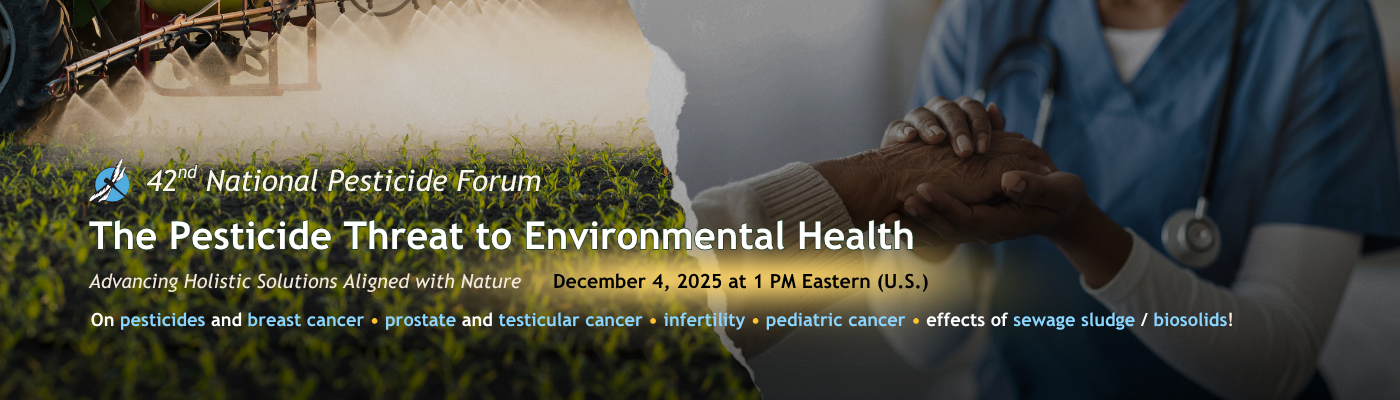
To advance principles of land management that align with nature, see the recording of Beyond Pesticides 42nd National Forum, The Pesticide Threat to Environmental Health: Advancing Holistic Solutions Aligned with Nature, which brings together scientists and land managers working to recognize and respect the ecosystems on which life depends. The second session is scheduled for December 4, 2025, 1:00-3:30 pm (Eastern time, US). This session features Carolina Panis, PhD, Jabeen Taiba, PhD, Emile Habimana, M.S., Génon K. Jensen, and Rossella Cannarella, M.D., PhD, in a compelling discussion that elevates public understanding of the scientific data linking petrochemical pesticides to the crisis in breast cancer, pediatric cancer, and sewage sludge (biosolids) fertilizer—supporting the imperative for ecological land management.
The information in this session empowers voices for the transition to practices and products that do not accept toxic chemicals as necessary when alternative systems are available to us. The science supports the urgent call for systemic change at this moment of health, biodiversity, and climate crises, with the promise of productive and profitable alternatives. This call for foundational change is motivated by our collective understanding that the critically needed response to the crises must not be diverted by anything less than a holistic strategy—recognizing the science on adverse effects of extremely small chemical doses to all organisms, including humans, and the synergistic effects of multiple chemical exposure.
The Thanksgiving Address (the Ohen:ton Karihwatehkwen) of the Haudenosaunee (also known as the Iroquois Confederacy or Six Nations—Mohawk, Oneida, Cayuga, Onondaga, Seneca, and Tuscarora) reflects their relationship to the Earth by giving thanks for life and the world around them. It is a prayer that is appropriate at any time, but especially on a holiday celebrating the abundance of the Earth’s gifts.
As you read this prayer, please take actions (actions that we have taken throughout the year) that align with our relationship to the natural world and her inhabitants. Beyond Pesticides thanks you for your support.
Click to read a personal and heartfelt Thanksgiving message from Jay Feldman, executive director!
“During this Thanksgiving and holiday season, I’m writing on behalf of Beyond Pesticides’ staff and board of directors to wish you a Happy Holiday. We celebrate with you our shared commitment to the values and principles that protect the well-being of people and the ecosystems on which life depends. In reflecting on the steps we are taking at Beyond Pesticides to confront existential health and environmental threats, I believe we, together, are pursuing a meaningful path forward—and I am thankful for that.”
If you can, please consider a gift sometime during this holiday season on our secure website at bp-dc.org/give2025. Your support of any size makes a tremendous difference! Thank you!